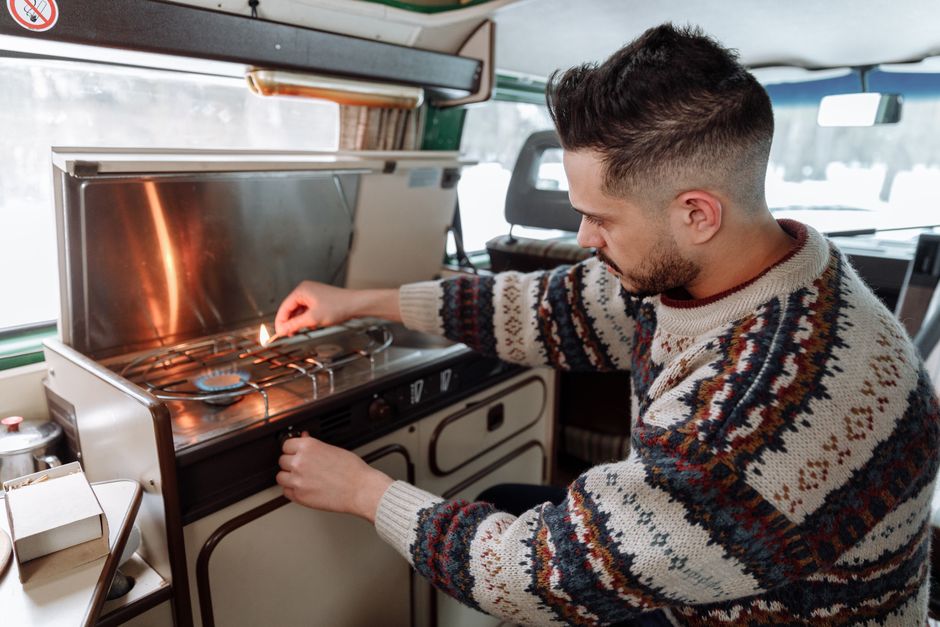
The Right Low-Wattage Air Fryer for Your RV or Camper
An air fryer is one of the hungriest small appliances you can plug into an RV. Whether it works comes down to one thing: your power setup. This guide routes you from how you camp to a compact air fryer your inverter, generator or hookup can run.
Updated June 2026·15 min read·Built around real 120V RV power limits, not spec-sheet wattage
Match the fryer to your power, not the other way round
Most air fryer round-ups rank baskets by how crispy the fries come out. In an RV that is the wrong first question. A full-size US air fryer commonly pulls 1500 to 1800W, and at 120V that works out to roughly 12.5 to 15 amps flowing the whole time it runs. Plug that into a rig with a small inverter or a 30 amp hookup and the limit you hit is not the recipe, it is the power. So this page starts where your trip starts: with how you actually get electricity.
The plan is simple. Tell us your power setup and how many people you cook for, and the router points you at a low-wattage compact air fryer that setup can run, plus the reason why. Then we show the 120V math behind it so you can sanity-check any unit against your own inverter, generator or hookup, compare five real compact fryers on the specs that matter in a camper, and frame each pick around the power setup it suits. There is also an honest list of what NOT to try, because the fastest way to ruin a trip is to trip a breaker or flatten a battery cooking dinner.
One ground rule throughout: wattage varies by model and model year, so we use qualitative tiers here, not invented exact numbers. Before you rely on any unit, read the wattage printed on its nameplate or label, usually on the base or the back, and check it against the power you have. That single habit is what turns this from a guess into a plan.
Interactive
Which low-wattage air fryer fits your RV power setup
Pick how you power the rig and how many you cook for. The router returns a wattage target and a compact unit that setup can actually run, with the reason behind it.
Route by your power
A starting point, not a guarantee. Always check your unit's nameplate wattage and your inverter, generator or hookup rating before you cook.
Your wattage targetLowest-watt compact (~1.2 qt)
Suggested air fryer
Dash Compact Air Fryer
about 1.2 qt, the lowest-draw unit here
Off battery and inverter, the lowest draw wins. The 1.2-qt Dash asks the least of your inverter and bank, which is what makes occasional boondock air-frying realistic at all. Pair it with a capable pure-sine inverter, not a token one.
Start with your power: what air fryer each RV setup can run
RV power is tiered, and each tier sets a hard ceiling on what you can cook. Find your setup below, see its ceiling, and read which class of air fryer fits. The compact, low-wattage units win at the bottom of this list and stay fine all the way up it, which is exactly why they are the safe RV choice.
Big inverter needed
Boondocking on battery + inverter
Power ceiling: Limited by your inverter and battery bank, not the wall
Fits: Lowest-wattage compact only, and only with a large pure-sine inverter and a healthy battery bank
Off-grid, the air fryer never touches shore power. Every watt comes from your battery through an inverter, and that is the bottleneck. A 1500 to 1800W fryer needs a large pure-sine inverter rated above its draw with surge headroom, fed by a battery bank big enough to sustain a heavy discharge for the length of a cook. A modest 1000W inverter and a single small battery cannot do it. If boondocking is your normal, buy the lowest-wattage compact you can find, run it only with a capable inverter and bank, and treat air-frying as an occasional treat rather than a nightly habit.
Match the surge
A portable generator
Power ceiling: Limited by the generator's running watts, with surge to spare
Fits: Low-wattage compact comfortably; a larger unit only if the generator's running watts clearly exceed it
A generator decouples you from the hookup, but its running-watt rating is now the ceiling, and the fryer's draw plus anything else running has to fit under it with margin. A small inverter generator in the 1000 to 1600W class is happiest with a low-wattage compact fryer and not much else on at the same time. Push a 1700W fryer onto a 1000W generator and it will overload or stall. Air fryers are a steady resistive load rather than a big motor, so the startup surge is mild, but you still want running watts comfortably above the fryer's nameplate, not equal to it.
Manage other loads
A 30 amp shore hookup
Power ceiling: About 3,600W for the whole rig (30A at 120V)
Fits: Compact or mid units fine, as long as you shed other big loads while it runs
A 30 amp service is a single 120V leg, which is 30 amps times 120 volts, roughly 3,600W for everything in the rig at once. That sounds like plenty until you remember the air conditioner, the water heater, the microwave and the converter all want a share. Run a 1500W fryer while the AC and microwave are going and you can trip the pedestal breaker. The fix is load management: turn off other heavy draws for the ten to twenty minutes the fryer runs. A low-wattage compact leaves far more of that 3,600W budget free, which is why it is the low-stress choice even on a hookup.
Plenty of headroom
A 50 amp shore hookup
Power ceiling: Two 120V legs, on the order of 12,000W total
Fits: Any air fryer here, with room for the AC and microwave at the same time
A 50 amp RV service delivers two 120V legs, on the order of 12,000W total, which is genuinely a lot of headroom. On 50A the air fryer stops being a power problem and becomes a kitchen-counter problem instead: you can run a full-size unit alongside the air conditioner without thinking about it. If you only ever stay in 50A parks, wattage barely constrains your choice, so pick on capacity, crisping and how little cabinet space it eats. Even here, though, a compact low-wattage fryer is the easiest to store, the fastest to preheat and the simplest to stow before you roll.
The 120V math
The 120V math: watts, amps, inverters and battery drain
Every routing decision above comes from one conversion and three sizing rules. Learn them once and you can check any air fryer against any power source yourself.
US RV outlets are 120 volts, and the conversion you need is watts divided by 120 equals amps. A fryer rated at 1500W draws about 12.5 amps while it runs; an 1800W unit draws about 15 amps, which is the full capacity of a standard household circuit on its own. A low-wattage compact in the 700 to 1000W class draws only about 6 to 8.3 amps, which is why it slips so easily under every RV ceiling. The number on the nameplate, divided by 120, is the amps you are committing to for the length of the cook.
For an inverter, the continuous rating has to exceed the fryer's nameplate wattage with margin, and it should be pure sine wave for clean heating. A 1700W fryer wants an inverter rated comfortably above 1700W continuous, so think 2000W or more, not a 1000W unit that will simply shut down under the load. Surge matters less for an air fryer than for a motor, because the heating element is a steady resistive load, but headroom on the continuous figure is non-negotiable.
For a generator, the same logic applies to its running-watt rating. The fryer's draw plus anything else running has to sit under the generator's continuous output with room to spare. A 1000 to 1600W inverter generator pairs well with a low-wattage compact and little else; it will not carry a full-size 1500W-plus fryer without straining. Size the generator to the load, then leave a cushion.
Battery drain trips people up because they reach for watt-hours when the real limit is rate. A cook is short, so the energy is modest: a 900W unit running fifteen minutes uses roughly 225Wh, and a 1500W unit for twenty minutes about 500Wh, before inverter losses. The catch is that while it runs the fryer pulls its full wattage continuously, and your inverter must supply every watt without tripping while the battery sustains a heavy discharge. That is why boondocking air-frying is an inverter-and-bank question first and a capacity question a distant second.
Watts to amps at 120V
Watts / 120 = amps
1500W is about 12.5A, 1800W about 15A, and a 700 to 1000W compact only about 6 to 8.3A. Read the nameplate, divide by 120.
Inverter sizing
Continuous rating above the nameplate
A 1700W fryer needs a pure-sine inverter rated well above 1700W continuous, not a 1000W unit. Surge is mild for a resistive heater; continuous headroom is what counts.
Generator sizing
Running watts above the load
Fryer draw plus anything else on must fit under the generator's running watts with margin. A small 1000 to 1600W generator suits a low-wattage compact and not much else.
Battery Wh per cook
Modest energy, heavy rate
Roughly 225Wh for a 900W unit over 15 minutes, about 500Wh for a 1500W unit over 20. The sustained high draw, not the Wh total, is what limits boondocking.
Read the fryer's nameplate wattage, divide by 120 for the amps, then confirm your inverter, generator or hookup carries that load with room left over. If it does not, drop to a lower-wattage unit rather than hoping.
Photo: PNW Production / PexelsCompare
Comparing 5 low-wattage air fryers for an RV or camper
Every unit here is a compact, low-wattage basket chosen to fit RV power. They differ on capacity, exactly how low the draw is, footprint and the power setup each suits best. Scan the table, then read the decision-framed picks below.
Wattage varies by model and year, so tiers are qualitative; always read the nameplate. Prices shift constantly, so we use tiers, not figures. Capacity is approximate.
The picks
The picks: a low-wattage air fryer for every RV power setup
Each unit is framed by the power setup it suits, not a leaderboard position. Find the card that matches how you camp, and you are looking at your pick.
Best power setupBoondock + small inverter, small generator
Best for boondocking
Dash Compact Air Fryer
The lowest-draw, smallest-footprint basket here, and the one genuine candidate for cooking off a modest inverter while boondocking.
Capacity: ~1.2 qtWatts: Low (~700 to 1000W)Footprint: Tiny, fits a single shelfPrice: Budget
Best for: Boondockers with a modest inverter and bank, solo cooks and couples
If you spend real time off-grid, start here. The whole reason this unit makes the list is its low draw: of the five, it asks the least of your inverter and battery bank, which is the difference between a fryer you can actually use while boondocking and one that trips your system the moment it heats up. Capacity is the trade. At about 1.2 qt it handles a single portion or a snack, a batch of fries for one, a few wings, reheating last night's pizza, not a family dinner in one go. That is fine for the solo traveler and the couple who do not mind cooking in rounds. The footprint is the smallest here too, so it disappears into a cabinet and weighs almost nothing on the inventory. As always, confirm the wattage on its base before you trust it to your inverter, and pair it with a capable pure-sine inverter and a healthy bank rather than a token 1000W unit and one small battery. Treat it as the off-grid specialist it is and it earns its keep.
Strengths
Among the lowest wattage you will find, so it is the gentlest load on an inverter or a small generator
Tiny footprint slips into a narrow RV cabinet or onto a single shelf, and stows fast before you roll
Cheap enough to leave in the rig as a dedicated camper fryer and not miss at home
Watch-out
At roughly 1.2 qt it cooks for one, maybe two at a push, so it is the wrong tool for feeding a family
Best power setupGenerator, 30A and 50A shore; boondock with a capable inverter
Best all-rounder
COSORI Lite 2.1-Qt Air Fryer
A low-draw 2.1-qt basket that crisps like a bigger unit, the safe single pick for most RVers who cook on a generator or shore power.
Capacity: ~2.1 qtWatts: Low (~900 to 1000W)Footprint: CompactPrice: Mid-range
Best for: Most RVers who want one do-it-all compact fryer that crisps well and still sips power
This is the one to buy if you only buy one. The Lite line is built around a smaller, lower-draw footprint than COSORI's full-size fryers, which lands it in the sweet spot for a camper: enough basket to cook a genuine meal for one or two, crisping that does not feel like a compromise, and a wattage that stays in the friendly low band. On a generator or a 30A or 50A hookup it just works, and with a capable inverter and a decent bank it can even handle the occasional boondock cook, though it is not the unit to run nightly off a single battery. The 2.1 qt basket is the practical capacity most RVers actually want: bigger than the single-serve Dash, small enough to preheat fast and stow easily. It tends to sit a step up in price from the bargain 2-qt units, and that buys you the brand's controls and crisping reputation. Check the nameplate wattage against your setup as you would with any unit, then enjoy a fryer that does not make you choose between power and a real dinner.
Strengths
Keeps draw in the low-wattage band while giving real cooking performance, a rare balance
About 2.1 qt feeds one or two comfortably and stretches to a small family in batches
Compact body fits typical RV counters and cabinets, with a clean modern control layout
Watch-out
Still too power-hungry to lean on nightly off a small inverter, so confirm your bank before boondocking with it
Best power setup30A and 50A shore, larger inverter generators
Best on shore power
Ninja AF080 Mini Air Fryer
Ninja's crisping in a 2-qt mini, the pick when you have a 30A or 50A hookup or a generator with real running watts to spare.
Capacity: ~2 qtWatts: Low-mid (around 1000W)Footprint: Compact, a bit tallerPrice: Step-up
Best for: Shore-power and strong-generator users who want Ninja-grade crisping in a small body
When power is not the constraint, this is the compact that cooks best. The AF080 mini brings Ninja's well-regarded crisping into a roughly 2-qt body that fits an RV counter, and on a 30A or 50A hookup, or a generator with running watts to spare, it is a joy to use. The catch for off-grid campers is that it sits toward the top of this low-wattage group, so it is the least suited to running off a small inverter and a single battery; treat it as a shore-and-generator unit rather than a boondock one. As ever, the nameplate is the source of truth, so divide its rated watts by 120 and confirm the amps fit under your hookup with the rest of your loads. If you mostly stay in parks with hookups and you care about how the food actually comes out, this earns its slightly higher price and its spot in the cabinet. It also makes a credible home fryer between trips, which softens the cost.
Strengths
Strong, even crisping and the Ninja basket finish, in a footprint sized for a camper
About 2 qt suits one or two and small batches, with a quick preheat
A polished, durable unit that doubles happily as your home fryer too
Watch-out
Sits at the higher end of this low-wattage group, so it is best on shore power or a generator with clear headroom, not a token inverter
A no-frills 2-qt fryer that keeps draw low and price lower, the value choice for generator and 30A camping.
Capacity: ~2 qtWatts: Low (~900 to 1000W)Footprint: CompactPrice: Budget
Best for: Budget-minded RVers on a generator or a 30A hookup who want simple, low-draw cooking
The TurboFry 2-qt is the value play: it covers the same low-wattage, compact-capacity brief as the pricier units for noticeably less money. For a generator or a 30A hookup, where you want a unit that sips power and does not complicate your load budget, it does the job without fuss. Simple manual or dial controls are an underrated virtue in an RV, where touchscreens can be finicky and you are often cooking in a small, moving space. The 2-qt basket handles a meal for one or two and small sides; it will not feed a crowd in one pass, which is true of every compact here. You give up some of the crisping refinement and the nicer finish of the step-up models, but for a first camper fryer or an occasional-use basket you keep in the rig, that is an easy trade. Confirm its label wattage against your generator's running watts or your hookup, and it slots neatly into a low-stress RV kitchen.
Strengths
Low-wattage draw that fits a small generator or leaves plenty of a 30A budget free
About 2 qt is enough for one or two, and the dial controls are dead simple in a moving rig
Easy on the wallet, so it is a low-risk first RV fryer
Watch-out
Plainer build and basic controls, without the crisping polish of the step-up units
Best for: First-timers and light, occasional users who want the cheapest way into RV air frying
If you are not yet sure air frying earns a place in your rig, this is the low-stakes way to find out. The Bella 2-qt is the cheapest unit here, with a compact basket sized for one or two and a draw that stays in the low-wattage band, which keeps it friendly to a 30A hookup or a mid-size generator. It is honestly built to a price: the feel is plainer and the crisping is the least refined of the five, so it suits light, occasional use rather than nightly cooking for a full-timer. For a weekender, a snowbird who air-fries now and then, or anyone testing the waters, that is exactly the right amount of fryer for the money. Keep your expectations matched to the price, check the wattage on the base against your power, and it will quietly cover the occasional batch of fries or wings without denting the budget or your power margin. When you outgrow it, the step-up units are waiting.
Strengths
Lowest cost of entry, so it is the easy way to test whether you will use a fryer on the road at all
Compact 2-qt body fits an RV counter and stores easily between trips
Stays in the low-wattage band, leaving headroom on a 30A budget
Watch-out
Built to a price, so expect a basic feel and the least crisping finesse of the group
What NOT to try (the fast ways to trip a breaker or flatten a battery)
Honest routing means naming the failure cases. Each of these is a common mistake that ends in an overload, a dead bank or a stalled generator. Avoid them and the picks above just work.
!Do not run a 1700W air fryer off a 1000W inverter
An inverter shuts down when the load exceeds its continuous rating, and a full-size fryer will exceed a 1000W unit instantly. Either fit a pure-sine inverter rated well above the fryer's nameplate, with a battery bank to match, or drop to a low-wattage compact that fits the inverter you have. Hoping it will cope is how you cook nothing and reset the inverter.
!Do not expect to air-fry while boondocking on a small battery
Off a single small battery and a token inverter, an air fryer is a non-starter. The sustained high draw drags the bank down hard, even though a short cook uses modest watt-hours. If boondock air-frying matters to you, build for it with a large inverter and a real bank, or accept that the fryer is a hookup-and-generator appliance for your rig.
!Do not match a tiny generator to a full-size fryer
A 1000W inverter generator cannot run a 1500W-plus fryer; it will overload or stall. The generator's running watts must clearly exceed the fryer's draw plus anything else on. Pair small generators with a low-wattage compact and run little else during the cook, or step up to a bigger generator before you step up the fryer.
!Do not run the AC, microwave and a big fryer together on 30A
A 30A hookup is about 3,600W for the whole rig, and stacking the air conditioner, microwave and a 1500W fryer at once will trip the pedestal breaker. Shed the other heavy loads for the ten to twenty minutes the fryer runs, or keep the fryer low-wattage so it leaves more of the budget free. Load management is the skill, not luck.
!Do not trust the box; read the nameplate
Marketing capacity and a model name do not tell you the draw, and wattage changes across model years. Find the wattage printed on the base or back of the unit, divide by 120 for the amps, and check that figure against your inverter, generator or hookup. Sizing to the label rather than the listing is what keeps you off the breaker.
Space and storage
Counter space, cabinets and stowing it for travel
Power decides whether the fryer runs; space decides whether you keep it. RV galleys are tight, so footprint and storage matter as much as wattage when you actually live with one.
Compact air fryers earn their place twice over in a camper: they sip power and they fit. A 1.2 to 2.6 qt unit lands roughly in the footprint of a large coffee maker, which means it can live in a cabinet and come out onto the counter only when you cook. The taller units need vertical clearance in the cabinet, so measure the shelf, not just the counter, before you buy. Leave a few inches of clearance at the back and top while it runs, because air fryers vent hot air and need to breathe.
For travel, the rule is the same as everything else in an RV: it has to be secured. A fryer is light but bulky, so wedge it into a cabinet with a non-slip liner and soft goods around it, or stow it in a bin so it cannot slide or tip on a hard turn. Empty and cool the basket before you roll, and check the lid or drawer is latched. The smallest units win here too, since a single-shelf footprint is easy to brace and forget.
Measure cabinet height, not just counter space; the taller minis need vertical clearance.
Leave a few inches of clearance at the back and top while it runs, so it can vent hot air.
Stow it on a non-slip liner, wedged with soft goods, so it cannot slide on the road.
Empty and cool the basket before travel, and confirm the drawer or lid is latched.
Pick the smallest capacity that feeds your crowd; in a galley, every saved inch counts.
Field tips
Field tips: cook smarter on limited RV power
Habits matter as much as hardware. These keep the draw low, the breaker happy and the food good, especially on a generator or a 30A hookup.
Cook on shore power or the generator, not the battery, whenever you can. Save the bank for fans, lights and the fridge, and run the fryer when you are plugged in or the generator is on.
Shed other big loads while it runs. Switch off the air conditioner, water heater or microwave for the ten to twenty minutes of a cook so the fryer has the budget to itself.
Skip the long preheat. Most compact fryers need little or no preheating; cutting it saves both time and a chunk of the energy a cook uses.
Cook smaller batches in a small basket. Overloading a compact unit means soggy food and longer run times; a single layer cooks faster and pulls power for less time overall.
Confirm the nameplate wattage once, then write the amps on a label. Knowing the draw at a glance makes load management automatic at every site.
On a generator, start the fryer after the generator is warm and steady, and avoid kicking on the AC compressor at the same moment to keep the load smooth.
Keep the vents clear and the unit on a heat-safe surface; a fryer that breathes well runs efficiently and finishes sooner.
Questions
RV air fryer FAQ
What size air fryer can I run in an RV camper?
It depends entirely on your power. On a 50A hookup you can run almost any air fryer, including a full-size 1500 to 1800W unit. On a 30A hookup, about 3,600W for the whole rig, a compact or mid unit is fine if you switch off other big loads while it runs. On a small generator or a modest inverter, stick to a low-wattage compact in roughly the 700 to 1000W class. Read the unit's nameplate wattage and divide by 120 to see the amps before you decide.
How many watts does an RV air fryer use, and how many amps at 120V?
Full-size US air fryers commonly pull 1500 to 1800W. At 120V the conversion is watts divided by 120, so 1500W is about 12.5 amps and 1800W about 15 amps, the full capacity of a standard household circuit. A low-wattage compact in the 700 to 1000W class draws only about 6 to 8.3 amps. Wattage varies by model and year, so always check the figure printed on the base or back of your specific unit rather than assuming.
Can I run an air fryer while boondocking on battery and an inverter?
Only with the right hardware. The air fryer draws its full wattage continuously through the inverter, so you need a pure-sine inverter rated well above the fryer's nameplate, fed by a battery bank big enough to sustain that heavy discharge. A 1000W inverter and one small battery cannot do it. If boondocking is your norm, choose the lowest-wattage compact you can find, pair it with a capable inverter and bank, and treat air-frying as an occasional cook rather than a nightly habit.
What size inverter do I need for an air fryer?
The inverter's continuous rating must exceed the fryer's nameplate wattage with margin, and it should be pure sine wave. A 1700W fryer wants an inverter comfortably above 1700W continuous, so think 2000W or more, not a 1000W unit that will shut down under the load. Surge headroom matters less than with a motor because a heating element is a steady resistive load, but never size the inverter equal to the fryer; leave clear continuous headroom.
Will an air fryer run on a 30 amp RV hookup?
Yes, with load management. A 30A service is a single 120V leg, roughly 3,600W for the entire rig. A compact or mid fryer fits easily, but only if you are not also running the air conditioner, microwave and water heater at the same time. Switch off other heavy draws for the ten to twenty minutes the fryer runs, or keep the fryer low-wattage so it leaves more of the 3,600W budget free. Stacking big loads is what trips the pedestal breaker.
Will a portable generator run an air fryer?
If its running watts clearly exceed the fryer's draw plus anything else on. A small 1000 to 1600W inverter generator pairs well with a low-wattage compact and not much else; it will not carry a full-size 1500W-plus fryer without straining or stalling. Air fryers are a steady resistive load, so the startup surge is mild, but you still want running watts comfortably above the fryer's nameplate, not equal to it. Size the generator to the load with a cushion.
Is a low-wattage air fryer worth it for an RV?
For most RVers, yes. A low-wattage compact in the 700 to 1000W class fits every power tier: it can sometimes run off a capable inverter while boondocking, it suits small generators, it leaves headroom on a 30A hookup, and it is effortless on 50A. It also stores small in a tight galley. The trade is capacity, since compact baskets cook for one or two and need batches for a family, but for fitting real RV power limits it is the safe choice.
How do I find my air fryer's wattage?
Look at the nameplate or rating label, usually printed or stamped on the base or the back of the unit, sometimes inside the drawer area. It lists the voltage (120V in the US) and the wattage or amperage. If only amps are shown, multiply by 120 to get watts; if only watts are shown, divide by 120 to get amps. Use that number, not the box or the product listing, to check the fryer against your inverter, generator or hookup.
Can I run two appliances at once on a 30 amp RV hookup?
Sometimes, if their combined draw stays under about 3,600W. Two small low-wattage devices can coexist, but pairing a heavy load like the air conditioner or microwave with a 1500W fryer will likely trip the breaker. The practical habit is to run the air fryer solo: turn off other big draws for the short time it cooks. A low-wattage compact makes this easier because it uses far less of the shared 30A budget in the first place.
Does air frying drain my RV battery a lot?
The energy a single cook uses is modest, roughly 225Wh for a 900W unit over fifteen minutes or about 500Wh for a 1500W unit over twenty, before inverter losses. The real strain is the rate: while it runs the fryer pulls its full wattage continuously, which forces a heavy discharge the bank and inverter have to sustain. A small battery handles the watt-hours but not the sustained draw, which is why off-grid air-frying needs a large inverter and a healthy bank, not just capacity.
Affiliate disclosure. This guide is reader supported. When you buy through links on this page we may earn a commission, at no extra cost to you. Picks are chosen on how well they fit real RV power limits, not commission. As an Amazon Associate I earn from qualifying purchases.
Power figures here are approximate planning numbers for sizing, not exact specifications. Wattage varies by model and year, so always read your unit's nameplate and confirm your inverter, generator or hookup rating before you cook. Follow the manufacturer's safety and ventilation instructions.